
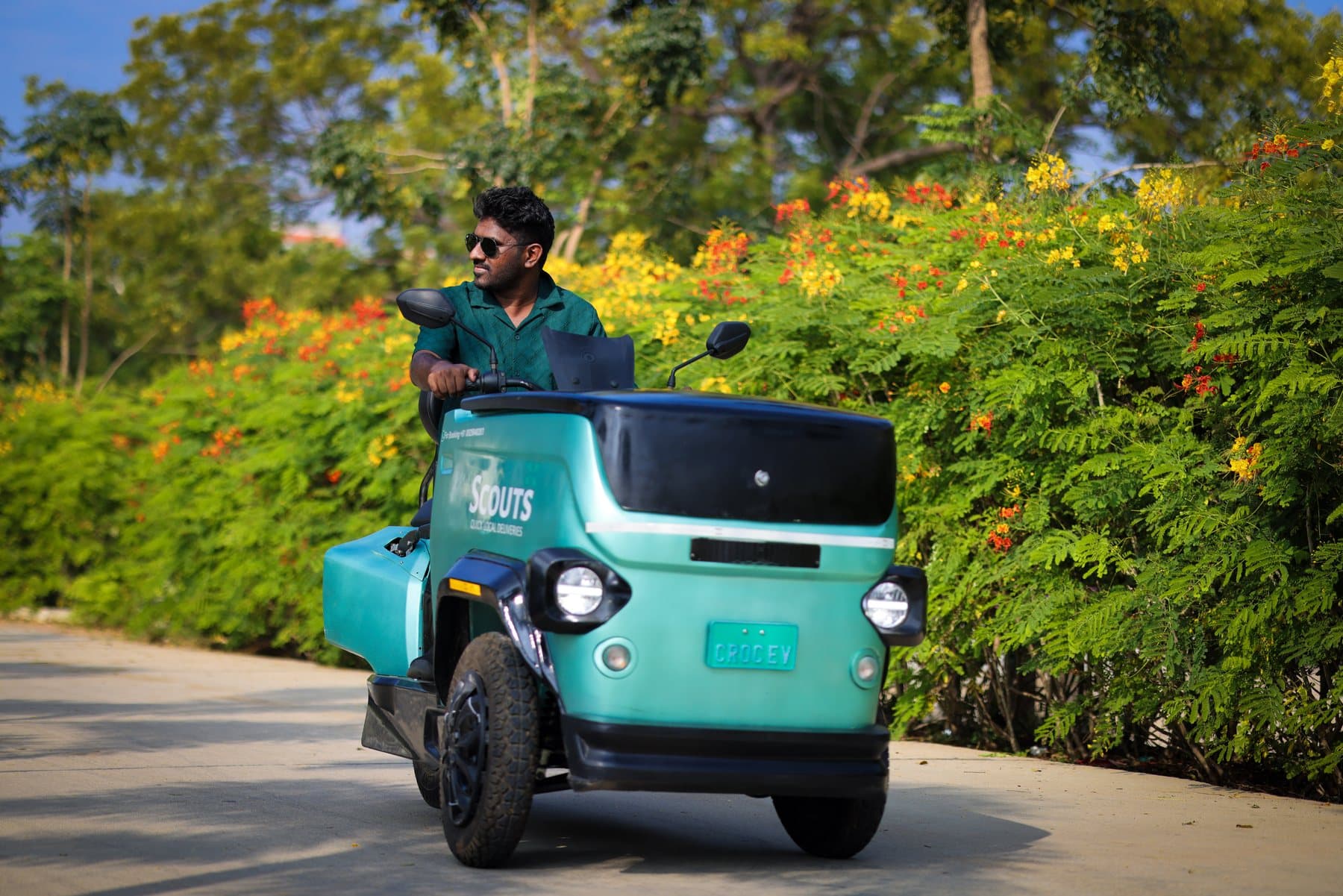
Picture a normal morning for a small business. A few crates of bakery trays. A carton of spare parts. A technician's tool kit. A stack of order parcels for one neighbourhood. It is too much to balance on a scooter, and far too little to justify sending a loader.
A large share of daily city work sits in exactly that gap. A reverse trike is one way to fill it. This post explains what the layout is, why it suits a cargo vehicle, and what it does not do, so you can judge whether it fits your own work.
The missing middle in city cargo
Most small goods in Indian cities move at one of two ends. At one end is a two-wheeler with a box, a crate or sacks strapped on behind the rider. At the other end is an e-loader or a small goods carrier, built for much heavier loads.
Between them is a band of work that is too bulky or awkward to carry safely on two wheels, but nowhere near the load a loader is built for: daily goods, shop refills, food trays, service kits and parcels. We call it the missing middle.
Speedloop Auto designed the RT100 platform for that band: 0 to 100 kg of payload. CROC EV is the first vehicle on RT100. It is rated for 80 kg, with a 25% overload allowance that takes it to 100 kg.
What reverse trike means
The three-wheelers most people know, the auto-rickshaw and the e-rickshaw, have one wheel in front and two behind. A reverse trike turns that around: two wheels in front, one behind.
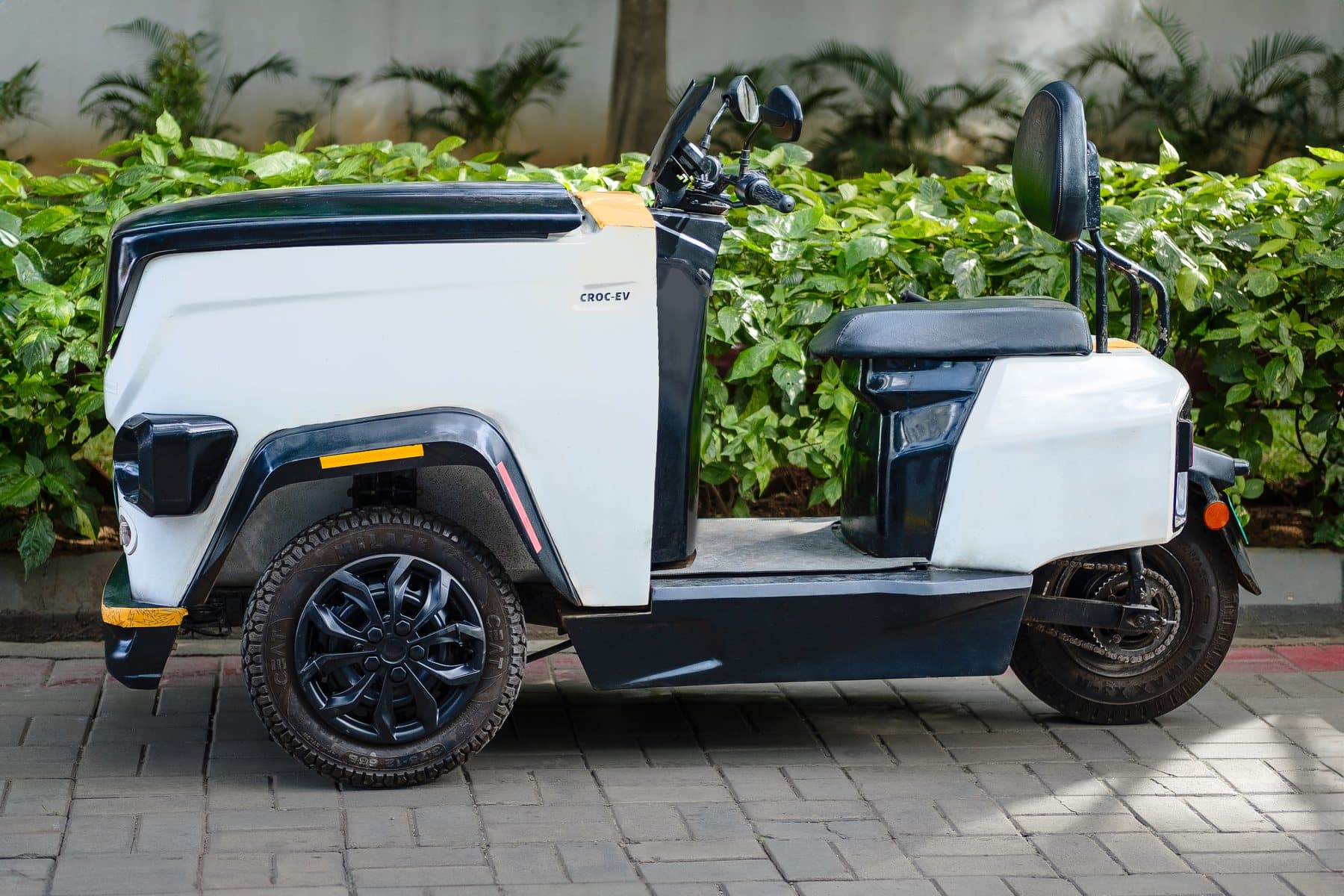
On CROC EV, the two front wheels sit under the cargo box, on double-wishbone suspension. The driver sits behind the box on a seat with a backrest and steers with a handlebar. A single rear wheel takes the drive through a gearbox and chain, and rides on a trailing arm with twin shock absorbers.
Underneath, a ladder and space frame ties the box, the front suspension and the seat together as one structure, so the load is carried by the chassis rather than hung off it.
Why put the load between the front wheels
The layout was chosen for the load first. Here is what it changes in daily use:
- The load sits between two wheels on a wide front axle, inside the frame, instead of hanging off the back of a two-wheeler and pulling at the rider's balance.
- The vehicle stands on its own. At a gate, a stop or a slow crawl through a market, the driver is not holding up the vehicle and the load with their legs.
- The driver can see the box. It is directly ahead, so a lid left open or a lock not set is noticed before moving off.
- It stays narrow. Two front wheels make it wider than a scooter, but the overall width is 930 mm, which still suits lanes, society gates and service entrances.
- The box is a proper box: 380 litres, lockable, FRP with steel reinforcement. Goods are closed in, not tied on.
What the layout does not do
A reverse trike is not the answer to every job, and it is better to know the limits before you buy.
It carries one person. CROC EV seats the driver only, with a backrest. It is a goods vehicle, not a passenger vehicle.
Its top speed is 25 km/h. That is in line with the e-cart category it is registered in, and it suits short, dense routes with frequent stops.
Its range is 40 km on one battery and 80 km with a second battery. Plan routes that start and end at your shop, kitchen or depot within that distance.
It is not for heavy loads. If your regular load is above 100 kg, you need a different vehicle. Titan EV is configured per site for factory and campus moves up to one tonne, and STIGER, a two-seat reverse trike for the 100 to 250 kg band, is in development.
Designed, built and certified in Pune
Speedloop Auto was incorporated in 2020. The first prototype and closed-loop trials followed in 2022, then the first platform in 2023, with a team of 30 and more than eight design iterations. ARAI certification came in 2024, making RT100 India's first certified reverse trike.
CROC EV registers as an e-cart, a registered commercial vehicle, and is approved for registration in Maharashtra and Tamil Nadu.
The layout in numbers
- Layout
- Reverse trike: two wheels in front, one behind
- Frame
- Ladder and space frame
- Front suspension
- Double wishbone
- Rear suspension
- Trailing arm, twin shock absorbers
- Overall width
- 930 mm
- Wheelbase
- 1440 mm
- Ground clearance
- 170 mm
- Payload
- 80 kg, plus 25% overload allowance
Is a reverse trike right for your work?
Start with the job, not the vehicle. Before you look at any cargo EV, write down four things:
- The heaviest load you carry on a normal day, in kilograms.
- How bulky it is: crates, trays, cartons, cans or kits.
- How many stops you make, and how far the whole day's route is.
- The hardest part of the route: the narrowest gate, the steepest ramp, the worst stretch of road.
If your answers land in the missing middle, send your route on WhatsApp to UrbanCarriers by Speedloop Auto at +1 (862) 504-0203, or tell us what you carry and where at speedloopauto.com/contact. Most buyers finance their vehicles, and UrbanCarriers can talk through financing support with you. For every figure in one place, see the CROC EV spec sheet.