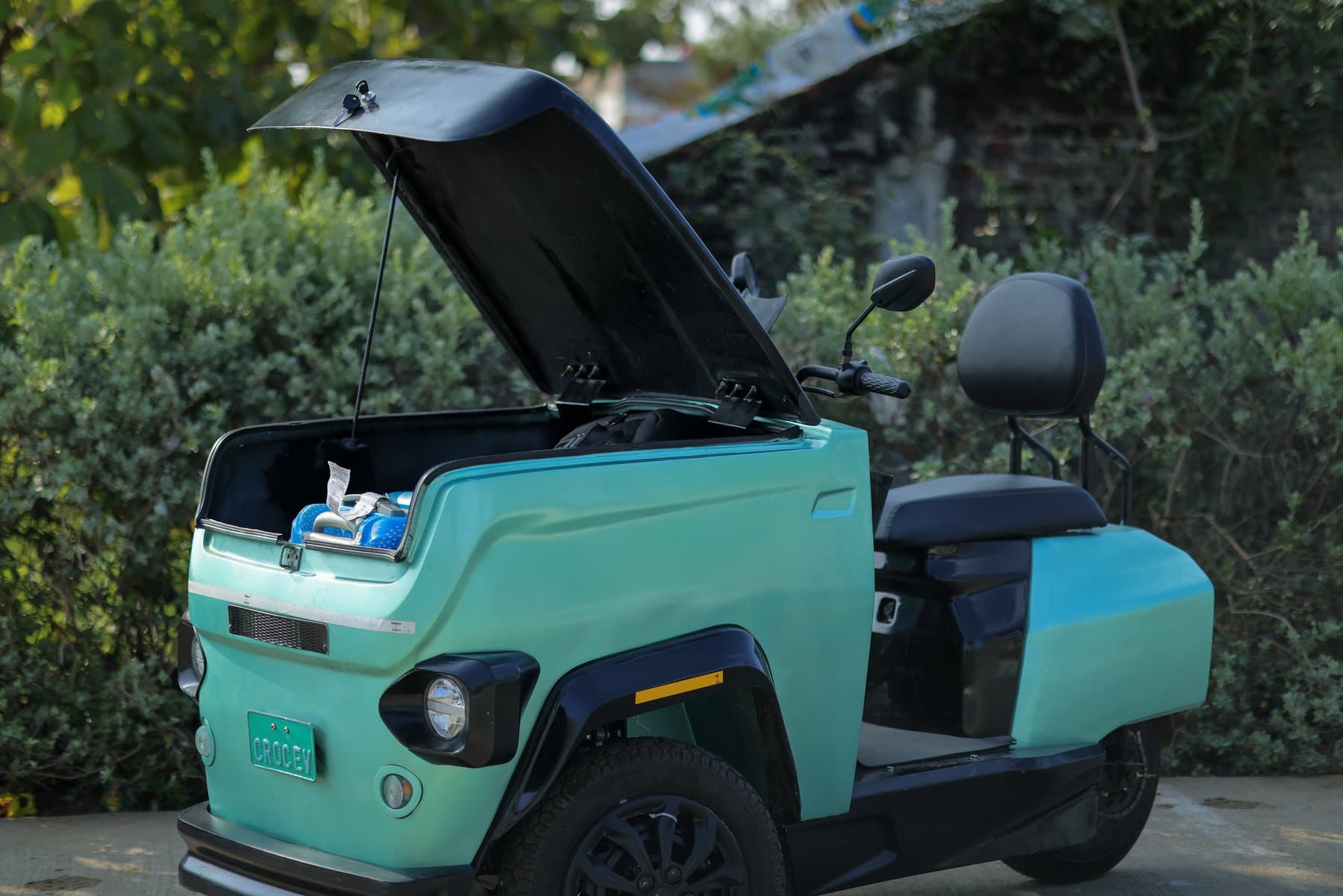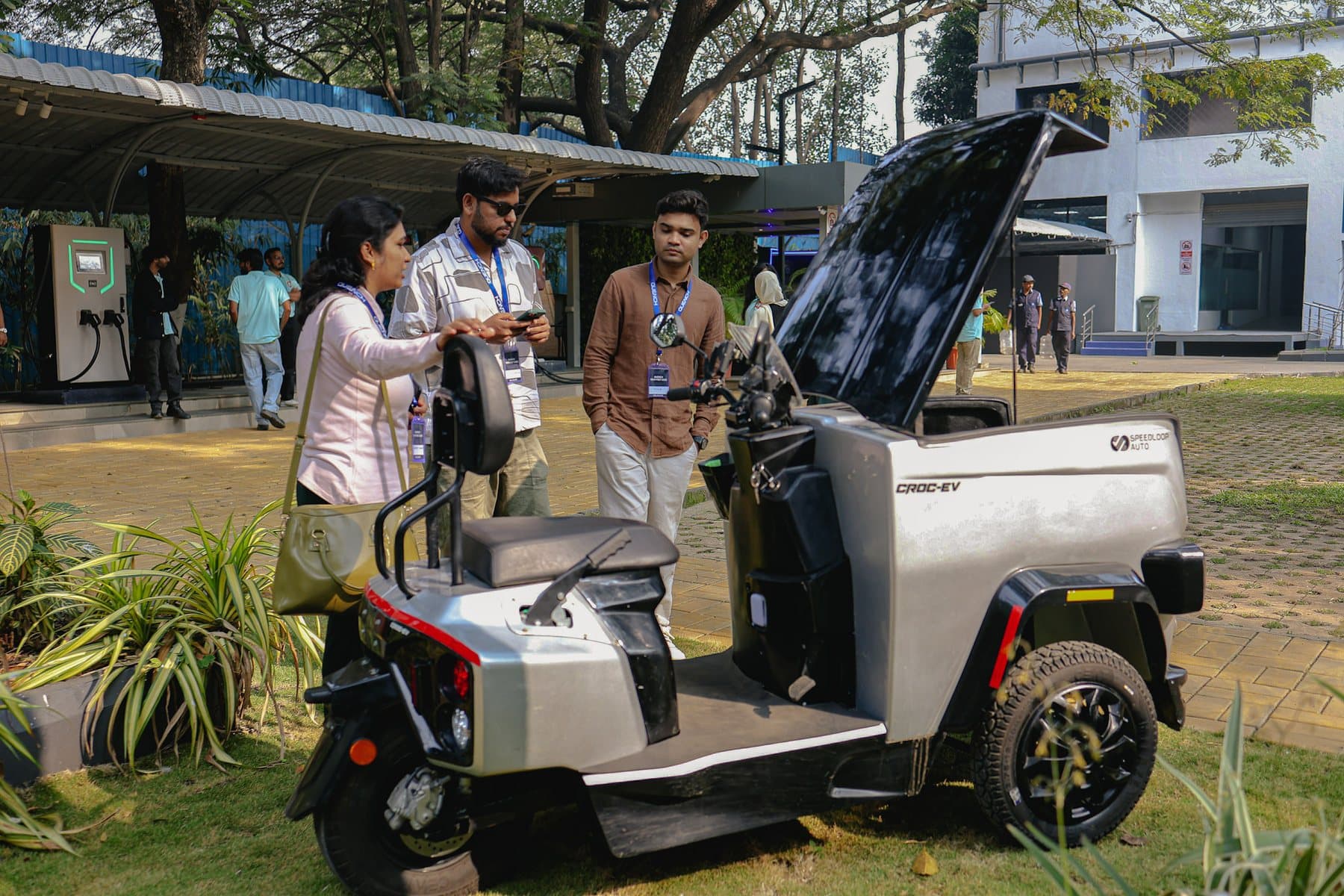

For most small businesses, the first worry about an electric work vehicle is not the vehicle. It is the charging. Where will it plug in? Does the shop need new wiring? What happens on a long day?
CROC EV was designed so that the answer is ordinary: it charges from a normal 5 A socket, with the charger that comes in the box, and no charging station is needed. But ordinary does not mean unplanned. Here is what to sort out before the vehicle arrives.
What the spec sheet says
Start with the facts, because every plan below depends on them.
Battery and charging
- Battery
- 2 kWh lithium-ion NMC, removable
- Charging
- About 2 h 30 min, 750 W charger, 5 A plug
- Charging station
- Not needed
- Range
- 40 km, 80 km with a second battery
- Battery care
- Smart thermal warning
- Starting
- Brake-to-start, sit-to-start, auto-off
In plain terms: one full charge takes about two and a half hours and gives one battery's worth of range, 40 km. A second battery doubles the day's range to 80 km.
So the questions to answer are simple. How far does the vehicle go in a working day? When is it standing still for a couple of hours? And where is the nearest socket at that moment?
Choose the socket before the vehicle arrives
The charger is made for an ordinary 5 A plug, so you do not need special equipment. You do need a sensible spot. Walk round your shop, kitchen, godown or depot and pick one that meets these points:
- An earthed 5 A socket in good condition. If the wiring is old, ask an electrician to check the socket and its circuit once before you start.
- Plugged in directly. Avoid extension boards and multi-plug adapters for daily charging.
- Dry and covered, out of rain and direct afternoon sun, with air around the charger.
- A cable path that does not cross a walkway or a doorway where people trip or carts roll over it.
- Permission in writing if the socket belongs to a landlord, a housing society or a client site.
Fit charging into the working day
The trick is to charge when the vehicle would be standing anyway. Two and a half hours fits into most working patterns. Three common ones:
- Overnight: the vehicle comes back in the evening and charges at the shop, kitchen or home. It starts the next day full. This suits single-shift routes within 40 km.
- A midday top-up: the vehicle charges during a lunch break or a slow afternoon while the business is still open. This suits split shifts with a morning and an evening round.
- Two batteries: because the battery is removable, a second battery can be charging while the first is on the road. The day's range becomes 80 km, and the vehicle does not have to stand still to recharge.
If you run two batteries on one charger, they charge one after the other, so plan two charge windows of about 2 h 30 min each. Write the pattern down for the driver, so charging becomes part of the routine rather than something remembered at the end of the day.
Working out the energy
You do not need a spreadsheet for this. A full charge is about 2 kWh, so multiply your tariff per unit by two. That gives the energy cost of one full battery, which is good for 40 km.
One thing to check: in general, the tariff that applies depends on the premises and the connection, so a shop, a home and an industrial unit may be billed differently. Look at the electricity bill for the place where the vehicle will charge, and use that rate.
Habits that look after the battery
A battery that is looked after stays useful for longer. These habits cost nothing:
- Use the charger that came with the vehicle, and keep it dry and off the floor.
- Park and charge in the shade where you can. If the smart thermal warning shows, follow the owner's manual before you carry on or plug in.
- As a general habit, give a hot battery time to cool after a hard run in afternoon heat before charging it.
- Unplug once charging is done, and coil the cable away from wheels and feet.
- Let the vehicle's auto-off do its job, and switch off properly at the end of the day.
For a facilities or fleet manager running several vehicles, give each one its own socket and charge window, and label the sockets. GPS tracking shows which vehicles are back at base and ready to plug in, and geo-fencing can flag a vehicle that has left its area.
Plan your charging with us
Tell us what you carry and where at speedloopauto.com/contact, with a note on where the vehicle will stand at night and how long your working day is. We will help you work out whether one battery or two suits the route. We can also talk through financing support.
Running a food business? Read the food and vending checklist, which covers charging around kitchen hours. Every battery and charging figure is also on the CROC EV spec sheet.