Milk before breakfast. Water cans to offices and homes. Gas refills to kitchens and small eateries. Daily-goods rounds are early, repetitive and unforgiving: if the run is late, the customer notices the same morning.
These loads have one thing in common. They are dense. A box that looks half-empty can already be at its weight limit. This post shows how to plan daily-goods rounds around CROC EV's 380-litre box and 80 kg payload, with the assumptions written down.
Daily goods are a weight problem first
For parcels and bakery trays, the box usually fills before the weight limit is reached. For milk, water and gas it is the opposite. A litre of water weighs about a kilogram, and milk is close to that. So with liquids, plan by kilograms first and litres second.
Loads also change through the week. Weekend orders, festival days and new customers can push a comfortable round over the limit without anyone noticing. Weigh the load on your heaviest morning, not your average one, and plan from that.
A worked example: 20-litre water cans
Here is the arithmetic for a water-can round, with every assumption listed.
- Assumption: a litre of water weighs about 1 kg.
- Assumption: each can holds 20 litres, so carries about 20 kg of water, plus the weight of the can itself.
- Three full cans: about 60 kg of water, plus three empty cans. That stays within the rated 80 kg.
- Four full cans: about 80 kg of water before the cans are counted, so the total goes into the 25% overload allowance. Acceptable now and then, not as the daily plan.
Weigh one empty can and add it to your own numbers. Then check your can fits the box: measure a can and send us its size, or try one in the box at a demo, before you plan the round.
Milk crates and gas refills
Milk: weigh one loaded crate on a normal morning, with pouches or bottles in it. Divide 80 kg by that figure to get the number of crates per round, and round down. Plan your stops so the heaviest drops come first and the vehicle gets lighter as the round goes on.
If your product must stay cold on the round, say so when you enquire, and plan your timing around it. Early starts and short rounds help.
Gas refills: plan by the filled weight of each cylinder, which is marked on it, not by its size. Follow your gas supplier's rules and the local rules on carrying cylinders, keep them secured so they cannot roll or tip, and never carry more than the payload allows.
The numbers for a daily-goods round
- Payload
- 80 kg, plus 25% overload allowance (100 kg)
- Cargo box
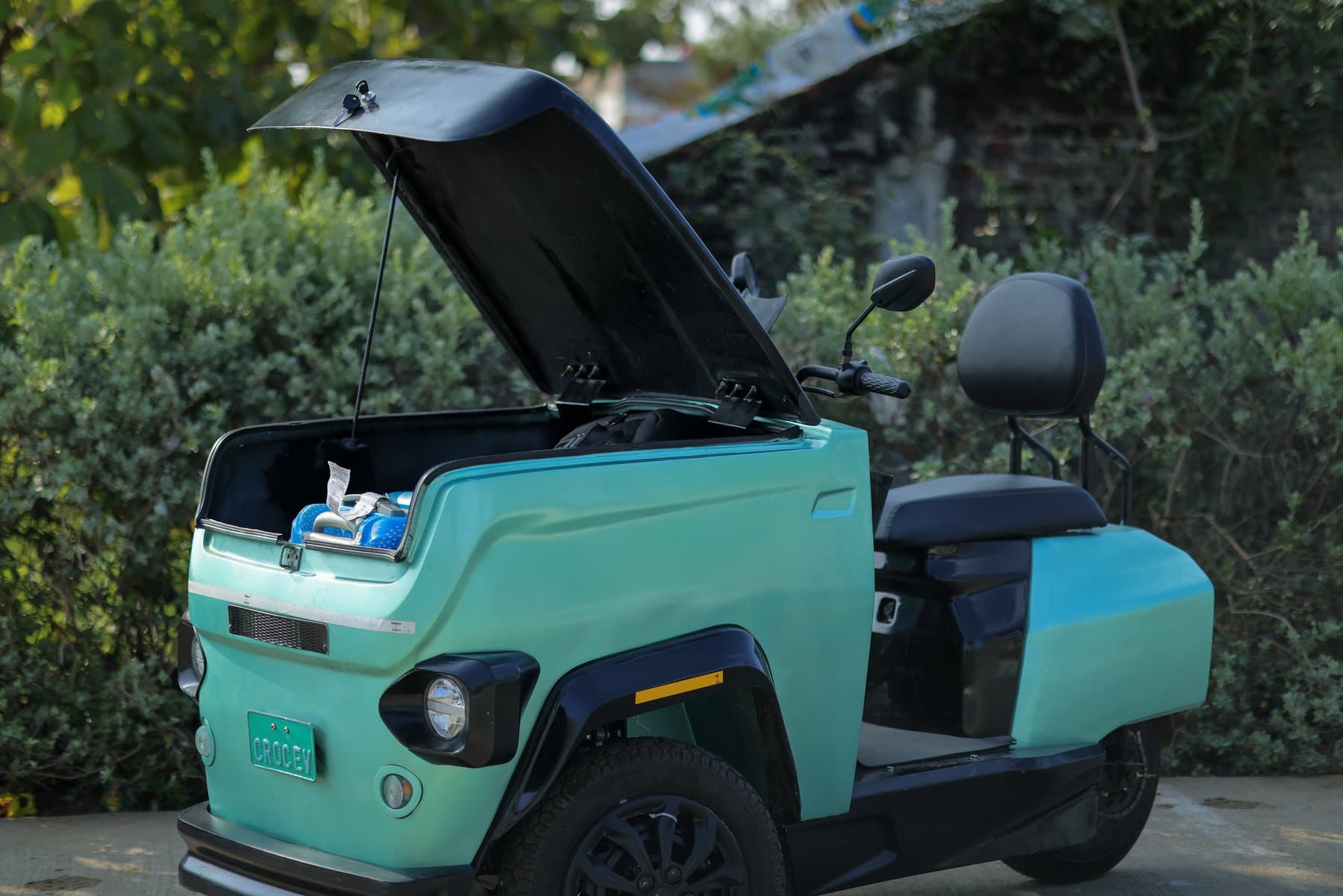
- 380 litres, lockable, in front of the driver
- Box build
- FRP with steel reinforcement
- Range
- 40 km, 80 km with a second battery
- Charging
- About 2 h 30 min from a 5 A socket
Planning the round, step by step
- List every stop for a normal morning, in the order you would visit them.
- Write the load for each stop in kilograms: crates, cans or cylinders.
- Add the loads up. Where the total passes 80 kg, split the stops into separate rounds, with a reload at the base between them.
- Add up the distance of all the rounds, including the trips back to base. Keep it within 40 km on one battery, or 80 km with a second battery.
- Allow for the top speed of 25 km/h and for time at each stop, and set the start time so the last customer is served on time.
- Mark a charge window: about 2 h 30 min from an ordinary 5 A socket, overnight or between the morning and evening rounds.
Empties matter too. Returned cans, crates and cylinders take up space on the way back, even when they weigh little. Leave room in the box for them on the last round.
Security on early rounds
Daily-goods rounds often start before shops open, with the vehicle left at the kerb while the driver carries goods up stairs or into a building. The box locks, and a smart e-lock is available as an option.
GPS tracking shows where each vehicle is, geo-fencing flags a vehicle that leaves its area, and remote lock lets an owner secure it from a distance. Brake-to-start, sit-to-start and auto-off add another layer at every stop.
Plan your round with us
Send your route on WhatsApp to UrbanCarriers by Speedloop Auto at +91 86250 40203, with your stops, loads and start time, or tell us what you carry and where at speedloopauto.com/contact. Most daily-goods businesses finance their vehicles, and we can talk through financing support with you.
Before you plan the charge window, read charging from an ordinary 5 A socket. If your loads regularly pass 100 kg, read how to right-size the vehicle first.