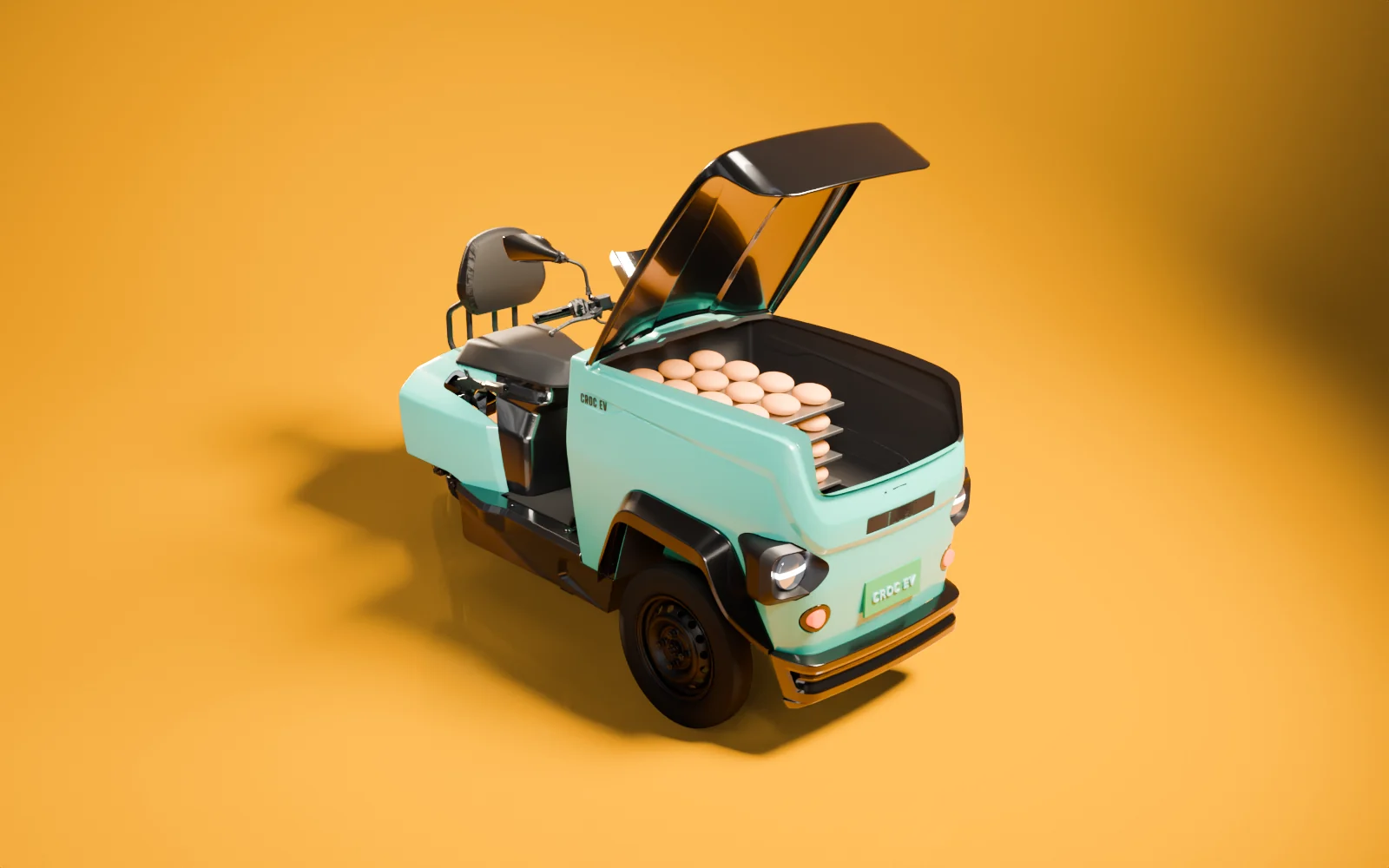
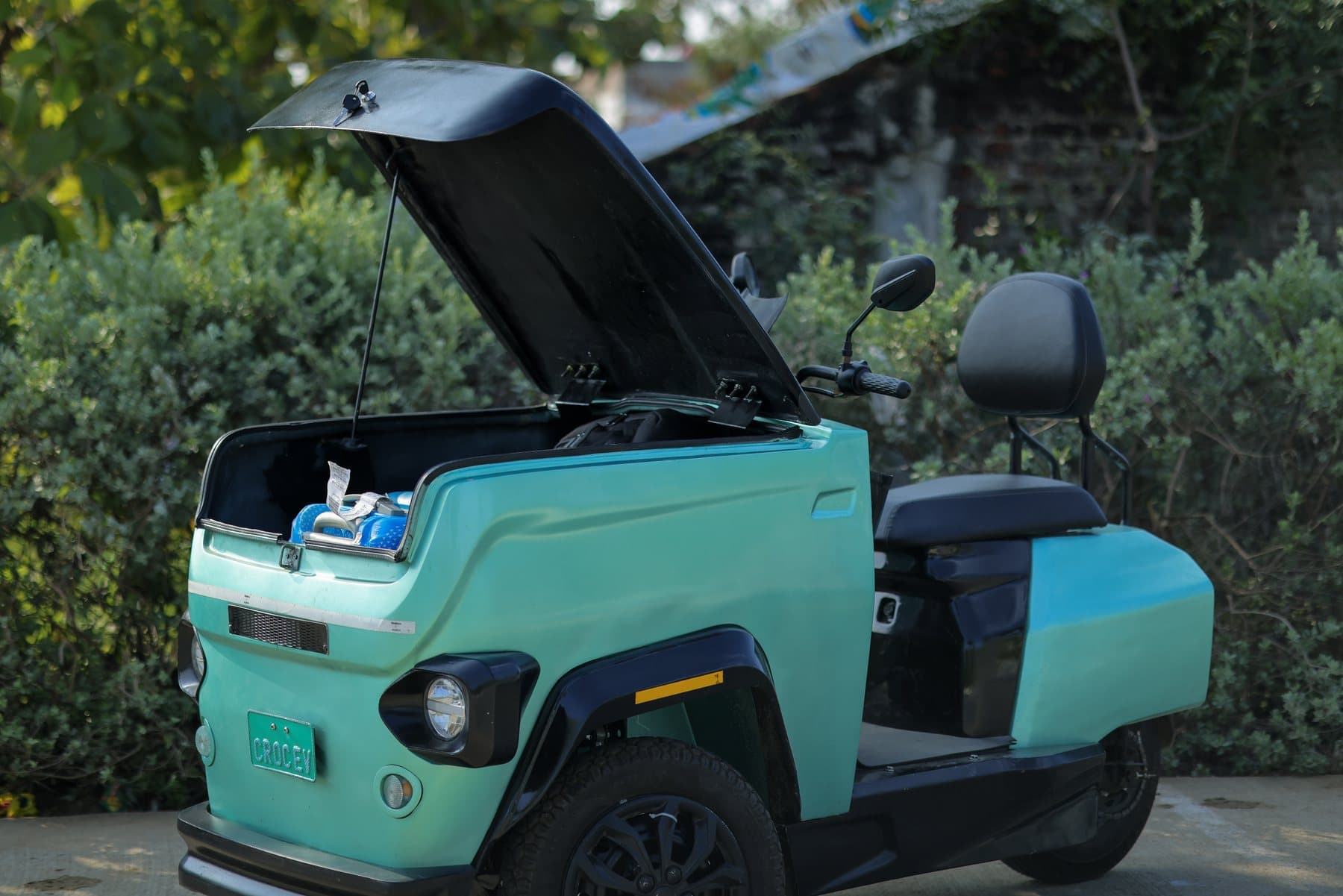
People who see CROC EV for the first time usually ask the same question: why is the box at the front? On most goods three-wheelers the load rides behind the driver, and on a scooter it is strapped on the back. We put it ahead of the driver, between the two front wheels, and we did it on purpose.
This post explains the reasons, from the point of view of the person who loads, drives and unloads the vehicle all day.
The load sits between two wheels, not behind one
CROC EV is a reverse trike: two wheels in front, one behind. The box sits over the two front wheels, inside the ladder and space frame, with double-wishbone suspension on each side. The load is carried by the chassis, across a wide front axle.
Compare that with a crate tied to the back of a two-wheeler. There, the load hangs behind the rider and pulls on their balance, most of all when they stop, start or turn slowly. With the box between two wheels, the vehicle stands on its own at a stop, and the driver is not holding up the vehicle and the load with their legs.
The box is not the payload
The box holds 380 litres, but CROC EV is rated for 80 kg, with a 25% overload allowance that takes it to 100 kg. The front box is built for loads that are bulky and frequent, not heavy. Plan by kilograms first.
The driver can see the load
When the box is in front, it is in the driver's line of sight all day. That sounds small, and in practice it matters at every stop:
- A lid left open, or a lock not set, is noticed before the vehicle moves off.
- At a busy stop, the driver can keep an eye on the box while they hand over an order a few steps away.
- If something shifts inside on a bad stretch of road, the driver sees it.
- Nobody can open the box behind the driver's back while they wait at a gate.
Loading and unloading from the kerb
Most of a delivery driver's day is spent stopping, not driving. With the box in front, the driver steps off the seat and the lid is right there, at waist height, opening towards them. There is no climbing round to the back, and no untying straps.
The box itself is FRP with steel reinforcement, lockable, and an optional smart e-lock is available. Goods are closed in rather than tied on, which keeps out rain and dust and keeps food, parts and parcels together.
Narrow enough for lanes and gates
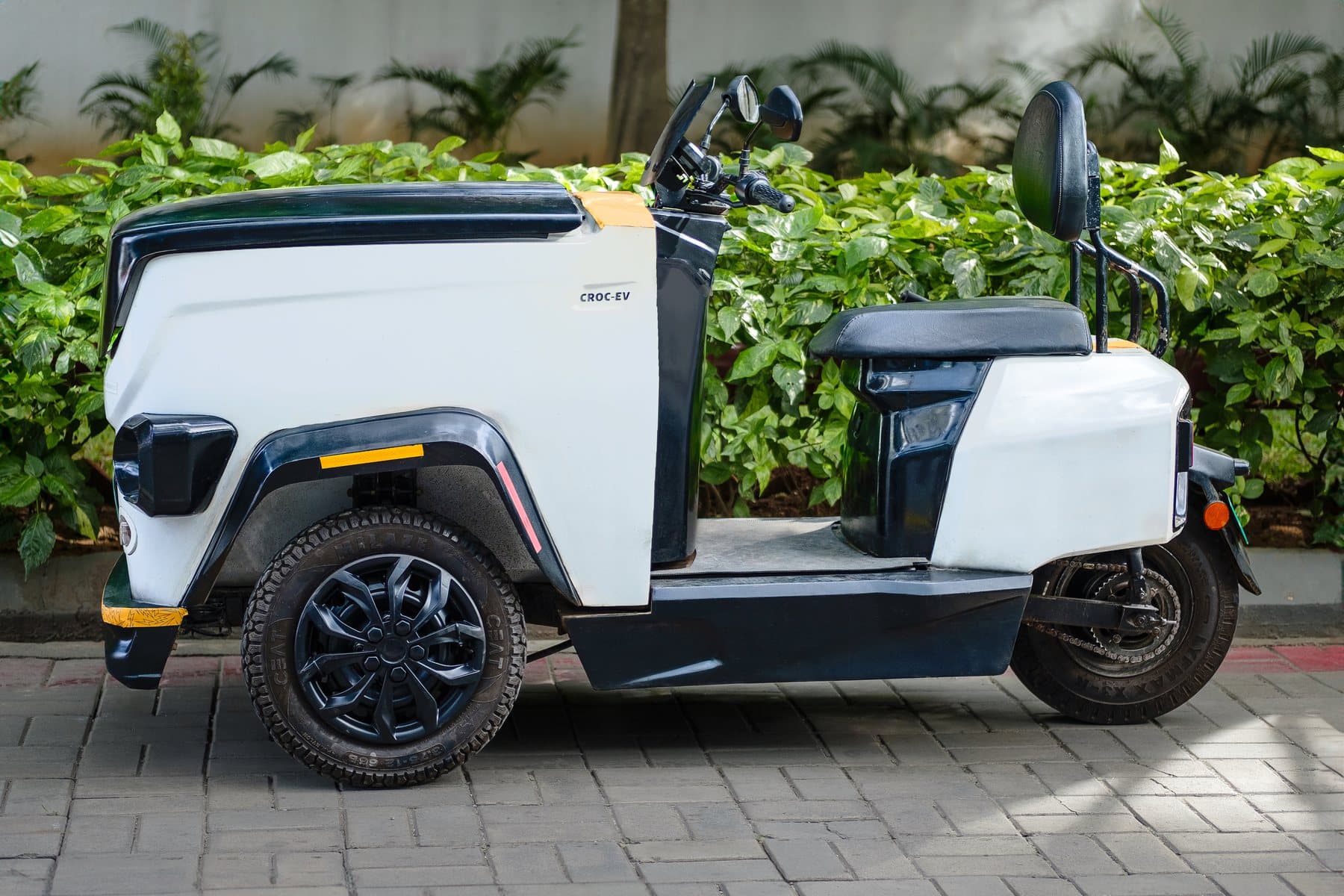
Two wheels in front make CROC EV wider than a scooter, but the overall width is 930 mm. That still suits narrow lanes, society gates and service entrances, which is where much of this work happens. The length is 2225 mm and the wheelbase 1440 mm, with 170 mm of ground clearance for speed breakers and broken edges.
What the front box is not for
A front box suits loads that are light to medium, bulky and frequent. It is not the right answer for everything:
- Regular loads above 100 kg need a different vehicle. Titan EV is configured per site for moves up to one tonne.
- Long items that do not fit a box are better on a flatbed or a body built for them.
- If you sell from the vehicle, a vending body built to order on the same chassis may suit you better than the box.
The front box in numbers
- Cargo box
- 380 litres, lockable, in front of the driver
- Box build
- FRP with steel reinforcement
- Cargo lock
- Smart e-lock, optional
- Payload
- 80 kg, plus 25% overload allowance
- Layout
- Reverse trike: two wheels in front, one behind
- Overall width
- 930 mm
- Length x width x height
- 2225 x 930 x 1270 mm
Check your load against the box
Tell us what you carry: the item, its size and how many at a time. Send it on WhatsApp to UrbanCarriers by Speedloop Auto at +91 86250 40203, or at speedloopauto.com/contact, and we will check it against the box with you. For the frame and suspension under the box, read inside the RT100 platform.
Your route
Tell us what you carry and where. We reply within one working day.
WhatsApp +91 86250 40203