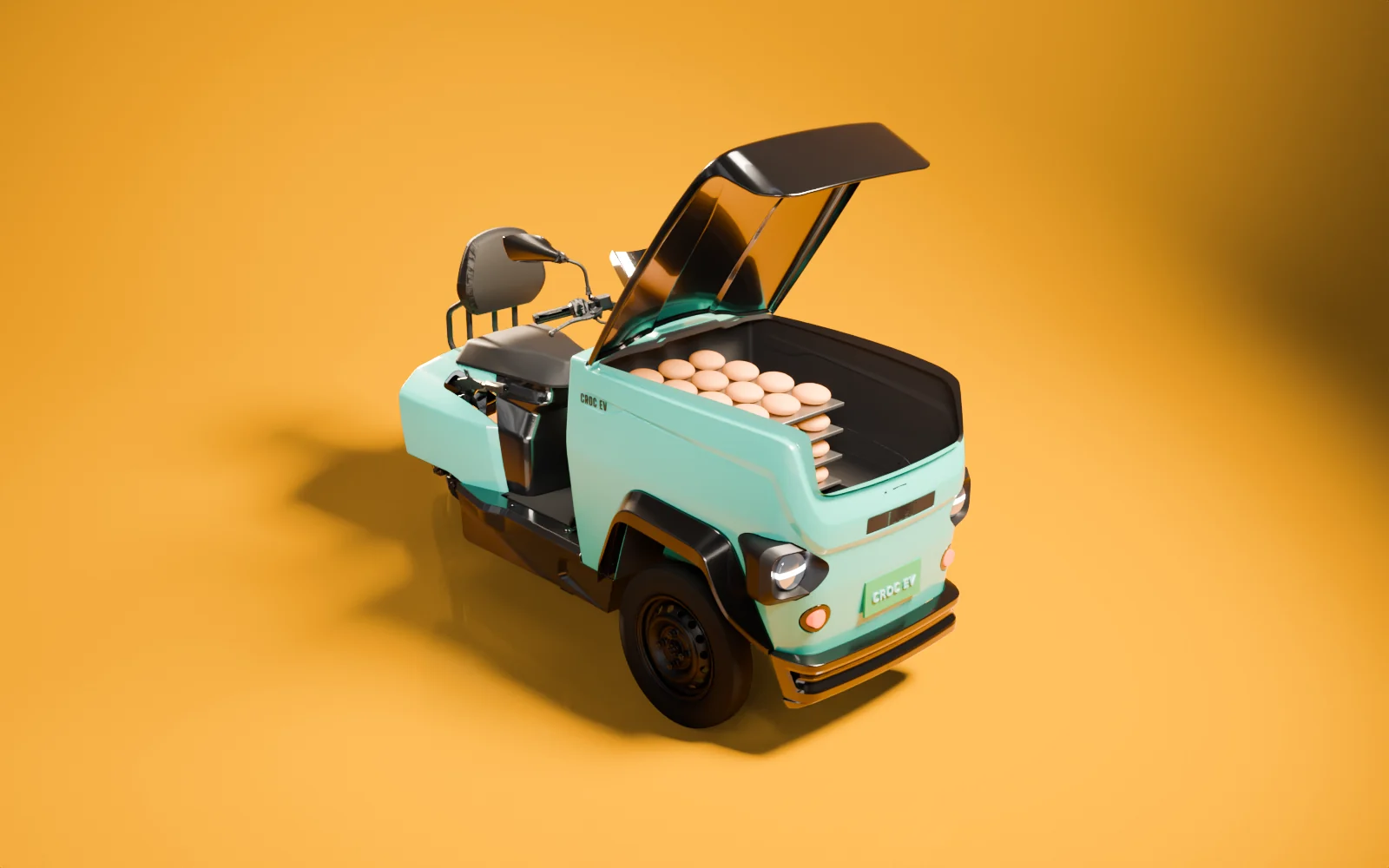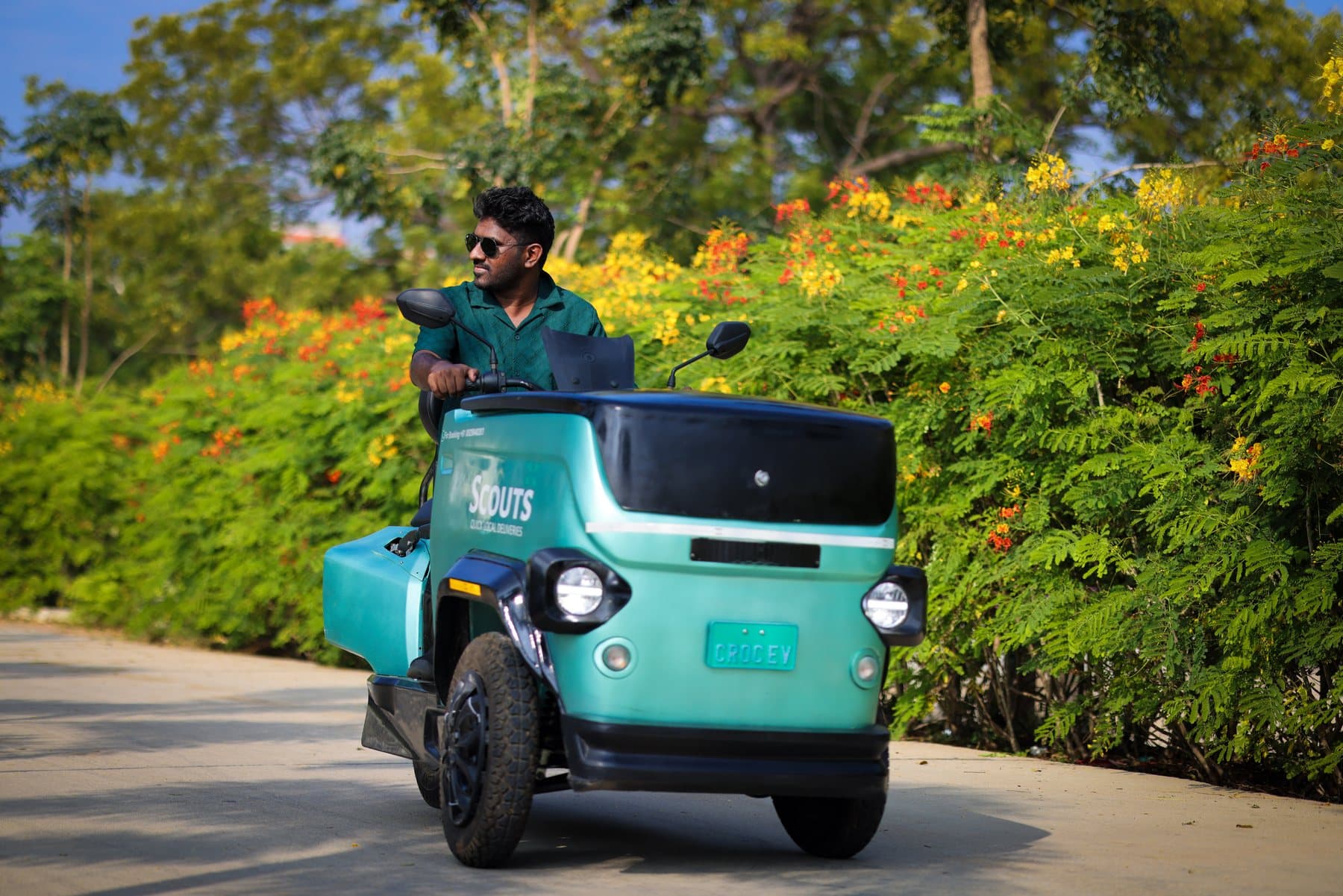
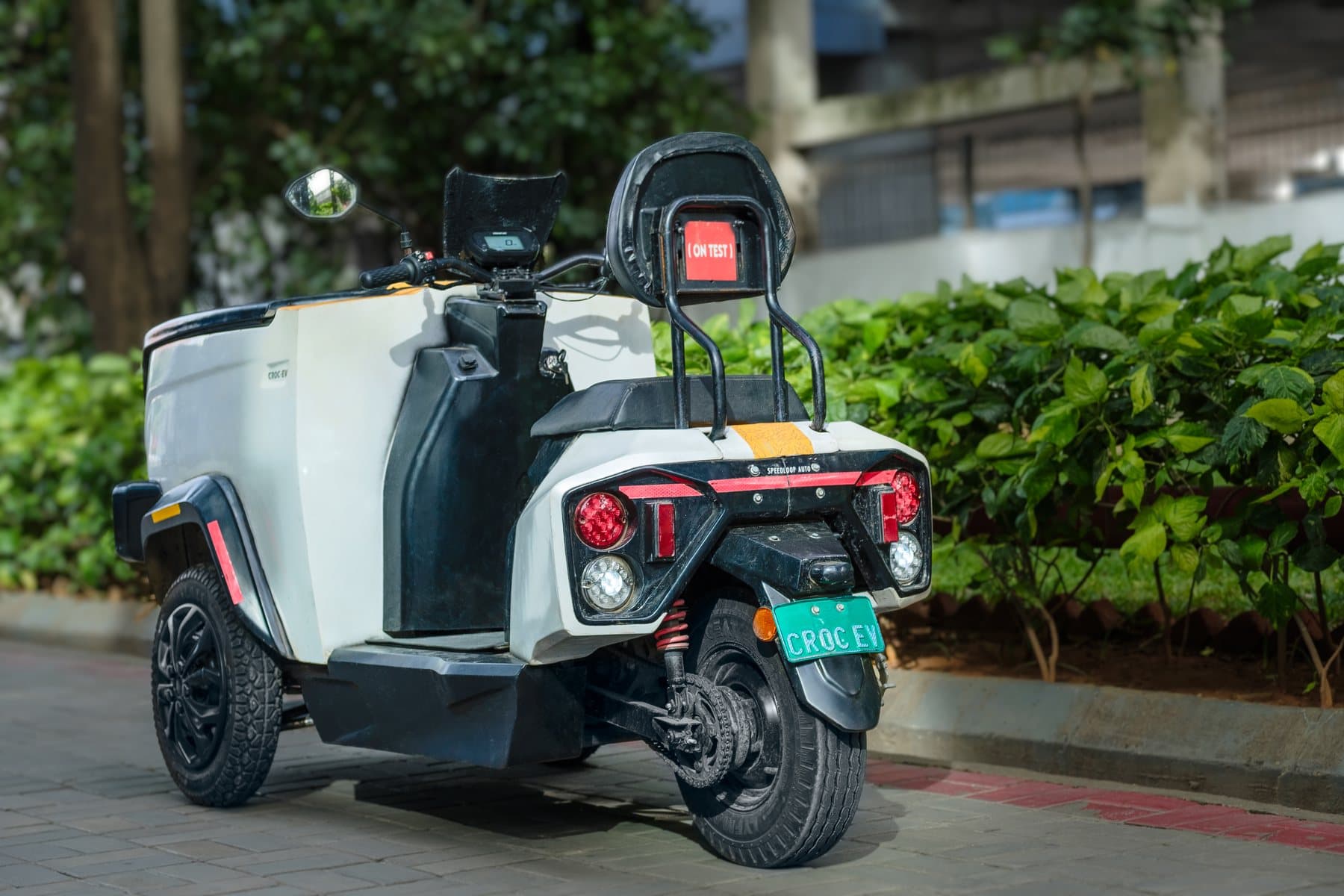
A buyer sees a vehicle: a box, a seat, a handlebar and three wheels. An engineer sees a platform: the frame, the suspension, the drive and the battery that every body on top of it shares. At Speedloop Auto we built the platform first. It is called RT100, and CROC EV is the first vehicle on it.
This post walks through what is underneath, part by part, and why each part is there. Every figure comes from the CROC EV spec sheet.
Why a platform, and why 0 to 100 kg
Small businesses in a city move a lot of goods that are too heavy or bulky for a two-wheeler and far too light for a loader: crates, trays, cans, cartons and kits. We call that band the missing middle, and we drew RT100 around it. RT100 covers 0 to 100 kg of payload.
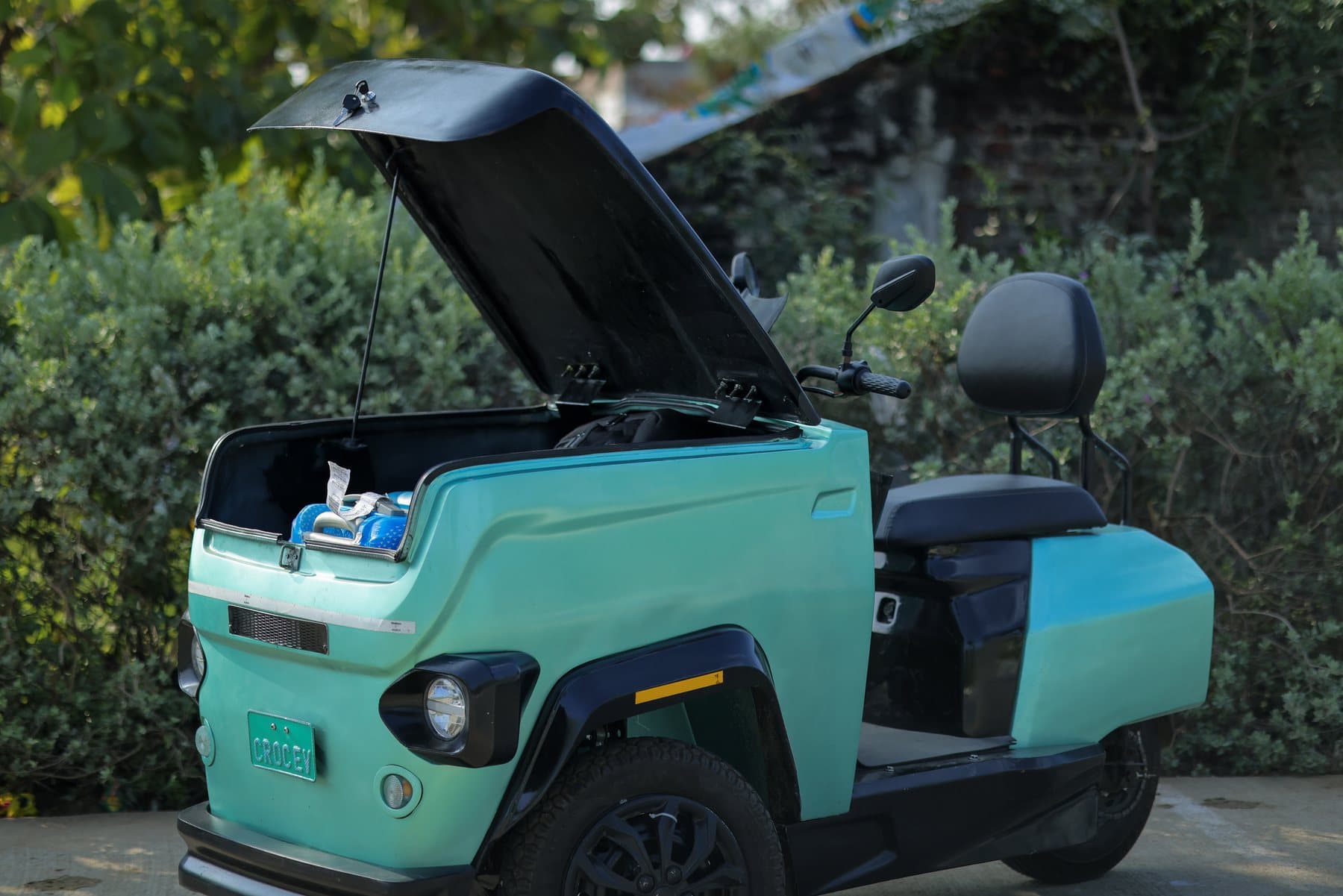
Designing for a band rather than a single product means one chassis can carry different bodies. CROC EV has a lockable 380-litre cargo box. Vending, sweeping and civic, and campus bodies are built to order on the same chassis. The work changes; the frame, suspension and drive underneath stay the same, and so do the parts and the service.
The band, in the vehicle's own numbers
CROC EV is rated for 80 kg, with a 25% overload allowance that takes it to 100 kg. That is the top of the RT100 band, and the platform is built for that load, not for more.
The frame: ladder and space frame
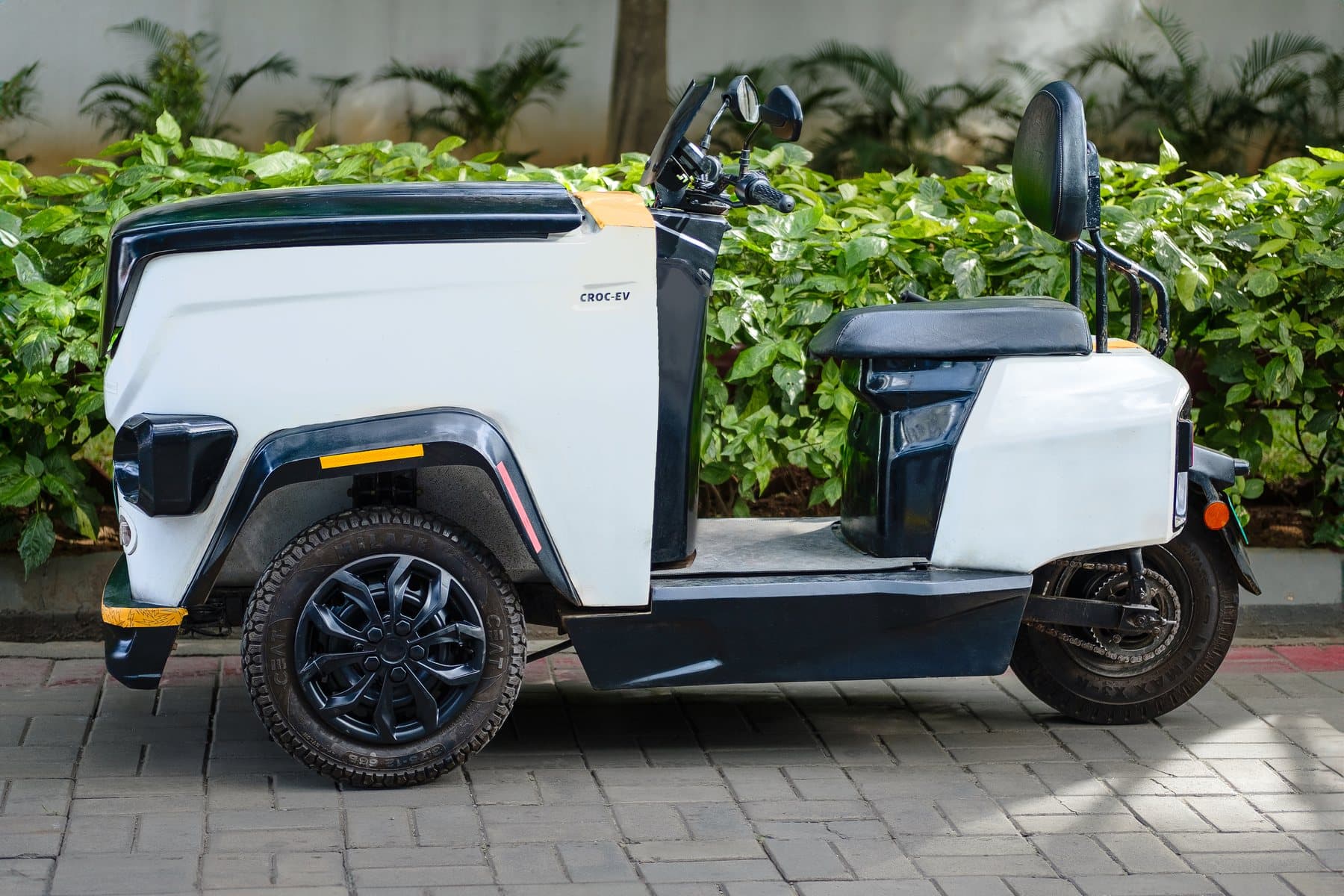
RT100 uses a ladder and space frame. The ladder part gives two long, straight rails to mount things on. The space-frame part triangulates the structure around the box and the seat, so loads are spread through the frame instead of bending a single member.
In practice, the cargo box, the front suspension and the driver's seat are tied into one structure. The load is carried by the chassis rather than hung off it, which matters on broken surfaces and at speed breakers, where a hanging load twists whatever it is bolted to.
Two wheels in front: double wishbone
RT100 is a reverse trike: two wheels in front, one behind. The front wheels sit under the cargo box, so they carry most of the load, and each one has its own double-wishbone suspension.
A double wishbone locates each wheel with two arms, one above the other. Each wheel moves on its own, so a pothole under one side does not throw the other side, and the wheel stays close to upright as it moves. For a vehicle that carries its load over the front axle, that means the box rides more steadily and the tyres keep their grip when the load is at its heaviest.
One wheel behind: trailing arm and twin shocks
The single rear wheel is the driven wheel. It is held on a trailing arm, a single arm pivoting ahead of the wheel, with twin shock absorbers. The drive reaches it from a mid-drive PMSM motor, rated at 1.3 kW with a 1.9 kW peak, through a gearbox and chain.
Putting the motor in the middle of the vehicle, rather than in the wheel, keeps the weight that the rear suspension has to move small. Taking the drive through a gearbox lets a modest motor pull a loaded vehicle away from a standstill, which is what a stop-start delivery route asks for all day.
The battery that comes out
The battery is a 2 kWh lithium-ion NMC pack, and it is removable. That matters for the people who use it. Many small businesses have no charging station and no parking spot with a socket, so the battery can be carried to an ordinary 5 A socket instead. A full charge takes about 2 hours 30 minutes with the 750 W charger that comes with the vehicle.
One battery gives 40 km. A second battery gives 80 km, which suits routes that run beyond one charge. Smart thermal warning watches the battery's temperature, and the vehicle uses brake-to-start, sit-to-start and auto-off.
Certified as a platform
RT100 is ARAI certified, which makes it India's first certified reverse trike. CROC EV registers as an e-cart, a registered commercial vehicle, and is approved for registration in Maharashtra and Tamil Nadu. Getting there took more than eight design iterations after our first prototype and closed-loop trials in 2022.
RT100 under CROC EV
- Payload band
- 0 to 100 kg
- Frame
- Ladder and space frame
- Front suspension
- Double wishbone
- Rear suspension
- Trailing arm, twin shock absorbers
- Motor
- Mid-drive PMSM, 1.3 kW rated, 1.9 kW peak
- Drive
- Single rear wheel, gearbox and chain
- Battery
- 2 kWh lithium-ion NMC, removable
- Wheelbase
- 1440 mm
- Ground clearance
- 170 mm
- Kerb weight
- 220 kg
What comes after RT100
RT100 is one band. Two more platforms are in development: STIGER, a two-seat reverse trike for 100 to 250 kg, and MANTIS, a utility cargo bike. For site moves up to one tonne, Titan EV is configured per site today.
If your loads sit inside the 0 to 100 kg band, a body on RT100 may fit your work. Before you decide, check these four things:
- Your heaviest normal load, in kilograms.
- The body you need: a closed box, a vending body or a sweeping body.
- Your longest day's route, in kilometres.
- The roughest stretch on that route.
Send those four on WhatsApp to UrbanCarriers by Speedloop Auto at +91 86250 40203, or tell us what you carry at speedloopauto.com/contact. To see what the layout means for the person driving it, read what a reverse trike is.
Your route
Tell us what you carry and where. We reply within one working day.
WhatsApp +91 86250 40203